Shopify leads e-commerce platforms in 18 of 21 markets; Magento and Tiendanube take the rest
multiecommerceLeer en español
Does AI recommend the same brands in every country?
In e-commerce platforms, ChatGPT, Gemini and Claude name 3 different leading brands across 21 markets over the 4 weeks ending September 14, 2026: Shopify in 18 of 21, Magento in Italy and Germany, Tiendanube in Argentina.
Record figures
- Distinct leaders
- 3
- Markets
- 21
- Netherlands (en)
- Shopify: 17.7%
- Chile (es)
- Shopify: 13.7%
- Spain (es)
- Shopify: 16.7%
- Italy (en)
- Magento: 12.4%
- Argentina (es)
- Tiendanube: 16.9%
- France (en)
- Shopify: 16.7%
- Global (es)
- Shopify: 19.2%
- Mexico (es)
- Shopify: 13.7%
- Global (en)
- Shopify: 16.4%
- Sweden (en)
- Shopify: 16.3%
- Germany (en)
- Magento: 10.4%
- Belgium (en)
- Shopify: 12.5%
- Poland (en)
- Shopify: 12.9%
- United States (en)
- Shopify: 18.5%
- United Kingdom (en)
- Shopify: 15.1%
- Colombia (es)
- Shopify: 16.3%
- Brazil (en)
- Shopify: 12.7%
- Uruguay (es)
- Shopify: 13.8%
- Peru (es)
- Shopify: 13.7%
- Canada (en)
- Shopify: 16.2%
- Switzerland (en)
- Shopify: 14.5%
- Answers naming the leader
- 3.1%
- Answers analysed
- 1150
- Window
- 4-week window closed on September 14, 2026
- Models
- ChatGPT, Gemini, Claude
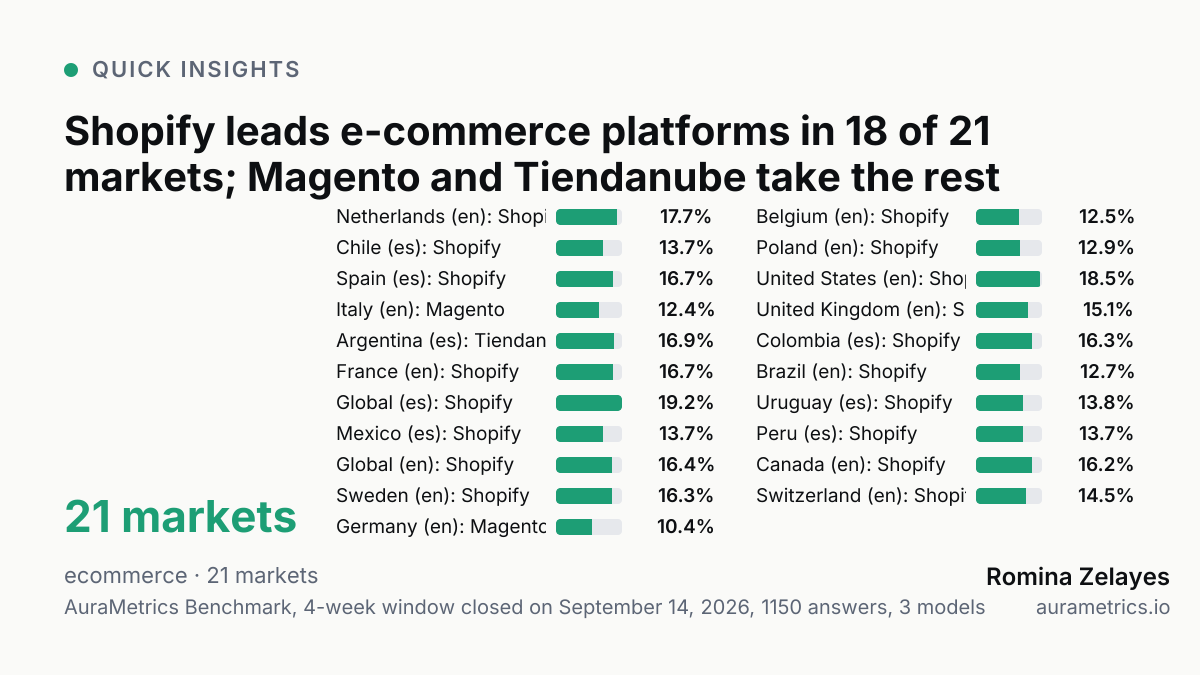
Three brands lead the e-commerce platforms category across the 21 markets I compared in the 4-week window closed on September 14, 2026, with 1,150 answers from ChatGPT, Gemini and Claude. Shopify sits first in 18 of the 21 markets. Magento takes the top spot in Italy and Germany. Tiendanube leads in Argentina. The pattern is close to uniform, with three markets that break from it.
The shares behind those leads move between markets. Shopify reaches 19.2% in the Spanish-language global set and 13.7% in Mexico. Tiendanube holds 16.9% in Argentina. Italy and Germany, together with Argentina, are the places where a different platform appears ahead of the brand that leads everywhere else. A marketing manager at a platform sitting second in one of the 18 Shopify markets reads this as a map of where the models already name an alternative first. An agency serving a regional platform looks at Argentina as the market where the models put that platform on top, and at Chile, Uruguay, Peru and Colombia as neighbouring Spanish-language markets where Shopify still holds first place. I read the three exceptions as the markets where the answers depart from the global picture.
How I measured it
In the 4-week window closed on September 14, 2026 I gathered 1,150 answers from ChatGPT, Gemini and Claude about e-commerce platforms in multi. The public benchmark measures every week which brands ChatGPT, Gemini and Claude name across 20 markets and 15 industries, in Spanish and in English. The models are queried through their APIs and without web search. Every mention is counted against a curated brand registry, with whole-word matching. Every brand that appears in a Quick Insight has been reviewed by a person. A brand's mention share is its part of the category's verified mentions in the period. The 95% interval is the margin of error of the share, calculated with the Wilson method. I calculate it on mentions and on answers. I publish a lead as clear when the second brand's share falls outside the leader's interval in both calculations. Inside it, it is a statistical tie.
Scope of the data
The figure covers the e-commerce platforms category in multi, with prompts in Spanish, on ChatGPT, Gemini and Claude, in the 4-week window closed on September 14, 2026; the models are queried through their APIs and without web search.
What to do with this figure
- Measure the brand with the same category prompts. Prompt Tracking runs prompts on the five engines.
- See which sources AI cites when it answers about the category. Prompt Tracking shows, for each prompt and model, the sources the answer cited, and AI Market Leaders groups them by brand.
- Cover the topics where AI leaves the brand out. Content Boost turns citation gaps into an editorial calendar with drafts.
About AuraMetrics
AuraMetrics measures how a brand appears in AI answers and validates the technical implementation behind that presence. The GEO Score is calculated on the GEO Framework, a public four-pillar methodology. It analyzes the sources AI cites. It measures visibility in ChatGPT, Gemini, Google AI Mode, Perplexity and Claude. It checks whether a shopping agent can buy from a store, with UCP checks. It turns citation gaps into a content plan with drafts. It generates llms.txt, OKF and ARD files. It delivers shareable reports and runs as white label for agencies. It publishes a weekly benchmark across 20 markets and 15 industries, and the Observatory of brands in AI.