Insurance software in the US: ChatGPT names Zywave, Gemini EZLynx and Claude Applied Epic
United States · Insurance softwareLeer en español
Do ChatGPT, Gemini and Claude recommend the same brands?
In insurance software in United States, ChatGPT, Gemini and Claude name different leaders over the 4 weeks ending September 14, 2026: Zywave, EZLynx and Applied Epic. The most recommended brand depends on which engine the person asks.
Record figures
- Applied Epic
- 1.6%
- Answers naming the leader
- 20.8%
- Answers analysed
- 96
- Window
- 4-week window closed on September 14, 2026
- Models
- ChatGPT, Gemini, Claude
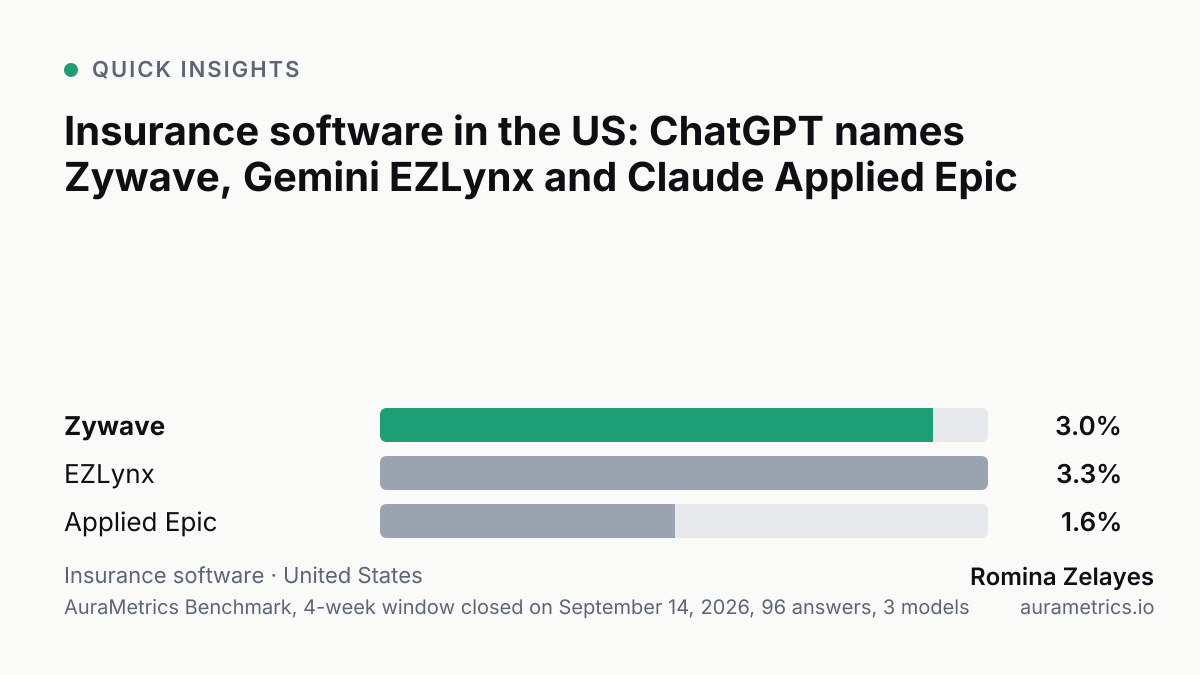
Three models, three leaders. In the 4-week window closed on September 14, 2026, across 96 answers about insurance software in the US market, ChatGPT put Zywave first, Gemini put EZLynx first and Claude put Applied Epic first. The aggregate ranking places Zywave at the top with 3.0% of mentions and presence in 20.8% of the answers, with EZLynx second at 3.3% of mentions and Applied Epic third at 1.6%.
The head of the category changes with the model that answers. Zywave leads on the number of answers it reaches, EZLynx leads on mentions and Applied Epic holds the first place inside Claude alone. For any other brand competing in insurance software, the reference is triple: the brand to beat in ChatGPT is a different one from the brand to beat in Gemini, and Claude adds a third name. The shares at the top stay low, the first two are separated by a narrow margin, and third place sits a step behind. A position in one model says little about the position in the other two; the same category question in ChatGPT, Gemini and Claude returns a different brand at the head in each one.
How I measured it
In the 4-week window closed on September 14, 2026 I gathered 96 answers from ChatGPT, Gemini and Claude about insurance software in United States. The public benchmark measures every week which brands ChatGPT, Gemini and Claude name across 20 markets and 15 industries, in Spanish and in English. The models are queried through their APIs and without web search. Every mention is counted against a curated brand registry, with whole-word matching. Every brand that appears in a Quick Insight has been reviewed by a person. A brand's mention share is its part of the category's verified mentions in the period. The 95% interval is the margin of error of the share, calculated with the Wilson method. I calculate it on mentions and on answers. I publish a lead as clear when the second brand's share falls outside the leader's interval in both calculations. Inside it, it is a statistical tie.
Scope of the data
The figure covers the insurance software category in United States, with prompts in English, on ChatGPT, Gemini and Claude, in the 4-week window closed on September 14, 2026; the models are queried through their APIs and without web search.
What to do with this figure
- Measure the brand with the same category prompts. Prompt Tracking runs prompts on the five engines.
- See which sources AI cites when it answers about the category. Prompt Tracking shows, for each prompt and model, the sources the answer cited, and AI Market Leaders groups them by brand.
- Review the site's technical signals with the GEO Score and the GEO Framework. The GEO Score scores the site from 0 to 100 on the four pillars of the GEO Framework. See Marco GEO
About AuraMetrics
AuraMetrics measures how a brand appears in AI answers and validates the technical implementation behind that presence. The GEO Score is calculated on the GEO Framework, a public four-pillar methodology. It analyzes the sources AI cites. It measures visibility in ChatGPT, Gemini, Google AI Mode, Perplexity and Claude. It checks whether a shopping agent can buy from a store, with UCP checks. It turns citation gaps into a content plan with drafts. It generates llms.txt, OKF and ARD files. It delivers shareable reports and runs as white label for agencies. It publishes a weekly benchmark across 20 markets and 15 industries, and the Observatory of brands in AI.