ChatGPT, Gemini and Claude Don't Recommend the Same E-commerce Platform. Here's the Data.
Ask ChatGPT, Gemini and Claude the same question: "What platform should I use to build an online store and sell?" You'd expect roughly the same answer. You don't get it.
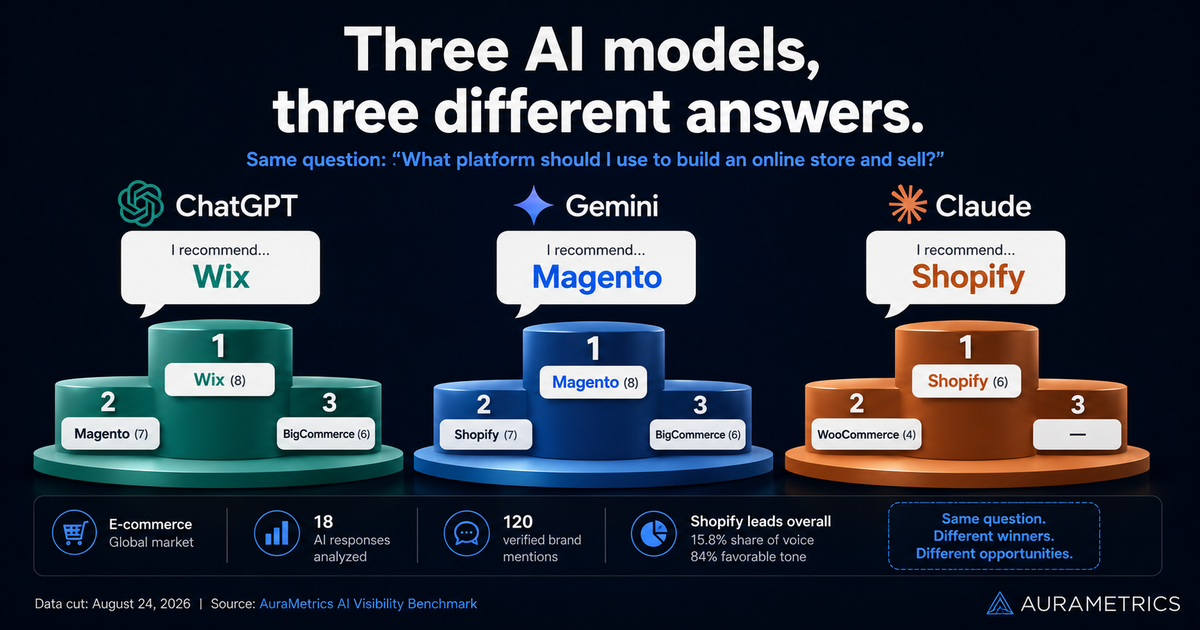
In our latest weekly cut (August 24, 2026), ChatGPT's most mentioned platform was Wix. Gemini's was Magento. Claude's was Shopify. Shopify, the overall leader across the three models combined, doesn't even appear in ChatGPT's top three.
This comes from the AuraMetrics AI Visibility Benchmark, where we track which brands the three models name across 15 industries and 20 markets, with 277,257 AI responses analyzed to date. Below is what the e-commerce data shows and why it changes how you should think about "being visible in AI".
The overall picture: Shopify leads, but not by much
Combining the three models for the global e-commerce cut, the share of voice looks like this:
- Shopify: 15.8% share of voice, 19 mentions, 84% favorable tone
- Magento (Adobe Commerce): 13.3% share of voice, 16 mentions, 50% favorable tone
- BigCommerce: 11.7% share of voice, 14 mentions, 29% favorable tone
- WooCommerce: 11.7% share of voice, 14 mentions, 64% favorable tone
- Wix: 10.8% share of voice, 13 mentions, 31% favorable tone
- Squarespace: 5.0% share of voice, 6 mentions, 33% favorable tone
- Mercado Pago: 3.3% share of voice, 4 mentions, 0% favorable tone
- IKEA: 2.5% share of voice, 3 mentions, 0% favorable tone
- Wayfair: 2.5% share of voice, 3 mentions, 67% favorable tone
Cut of August 24, 2026. E-commerce, global market. 18 AI responses analyzed, 120 verified brand mentions.
Two things stand out before we even split by model. First, the top five are packed within five percentage points. There's no dominant brand; there's a leader and four challengers. Second, mentions and recommendations are not the same thing: BigCommerce and Shopify have similar share, but 84% of Shopify's mentions appear in a favorable context versus 29% for BigCommerce. Being named a lot while being framed as "more complex" or "for enterprise only" is a very different kind of visibility.
Split by model, the ranking falls apart
Here's where it gets interesting. The three models receive exactly the same prompts. This is what each one puts on the podium:
ChatGPT
- Wix, 8 mentions
- Magento, 7 mentions
- BigCommerce, 6 mentions
Gemini
- Magento, 8 mentions
- Shopify, 7 mentions
- BigCommerce, 6 mentions
Claude
- Shopify, 6 mentions
- WooCommerce, 4 mentions
(no third brand reached the podium in this cut)
Numbers in parentheses are mentions in this cut.
Read that table twice:
- Wix leads ChatGPT and is absent from the other two podiums. If your only tracking tool is ChatGPT, you'd conclude Wix is winning. It isn't, overall. It sits fifth combined and dropped two positions versus the previous cut.
- Shopify, the combined leader, is not in ChatGPT's top three. A Shopify marketing team looking only at ChatGPT would think they have a visibility problem. Looking only at Claude, they'd think they're untouchable.
- Claude names fewer brands and concentrates them. Its podium has two entries because it tends to give shorter, more decisive answers. That makes each mention on Claude proportionally more valuable and harder to get.
- BigCommerce is the only brand that shows up consistently in the same spot on two models. Consistency across models is its own kind of strength, even at third place.
The takeaway isn't that one model is "right". It's that each model has its own sources, its own training data and its own idea of what a good answer looks like. They disagree, and they'll keep disagreeing.
Why this matters for your brand
1. "AI visibility" as a single number is misleading. A combined share of voice hides the fact that you might be strong on one model and invisible on another. If your buyers use Gemini (increasingly the case through Google's AI Mode) and you're only optimizing for what ChatGPT says, you're measuring the wrong channel.
2. Each model rewards different signals. Our cuts consistently show that Gemini leans on structured, entity-rich sources and Google's own knowledge graph, ChatGPT pulls heavily from comparison articles and listicles, and Claude favors concise, well-established consensus. Where your brand is cited (and by whom) determines which model picks it up. That's why we track key sources alongside mentions.
3. The gaps are the opportunity. Where the models differ is exactly where a targeted content effort can move the needle. Shopify has room on ChatGPT. Wix has room on Gemini and Claude. Magento is well positioned on two models but carries a 50% favorable tone, which suggests its mentions come with caveats worth addressing.
4. Small samples move fast. Each weekly cut for a single industry is a few dozen responses. Rank changes of one or two positions week to week are normal and shouldn't trigger panic or celebration. The pattern that matters is the one that holds over four or more cuts. That's why we publish the weekly series, not just the latest snapshot.
What the models get wrong
One more detail from this cut. Mercado Pago, IKEA and Wayfair all appear as answers to "which platform should I use to build a store". None of them is an e-commerce platform. Mercado Pago is a payment provider, IKEA and Wayfair are retailers.
This is the models confusing "companies associated with online selling" with "tools to sell online". It happens more than you'd expect, and it's a reminder that raw mention counts need verification before you act on them. Every mention in our benchmark is verified against a brand catalog before it counts.
How we built these numbers
- Three models: ChatGPT, Gemini and Claude, queried with identical prompts.
- Prompts describe a real buyer need ("I want to create an online store and sell, what should I use?") without naming any brand.
- Every response is parsed for brand mentions, matched against a verified catalog and classified by tone (favorable, neutral, unfavorable).
- Weekly cuts. The series is public and you can see it as a table on the benchmark page.
Live benchmark, all 15 industries and 20 markets: aurametrics.io/benchmark
Is your brand in the ranking?
The benchmark covers the biggest brands in each industry. If yours isn't in the list, or if it's there but with a tone you don't like, you can run a free audit and see exactly what each model says when someone asks about your category.
Written by