What Is the Best AI Visibility Tool in 2026? A Complete Guide
Why AI Visibility Tools Matter More Than Ever
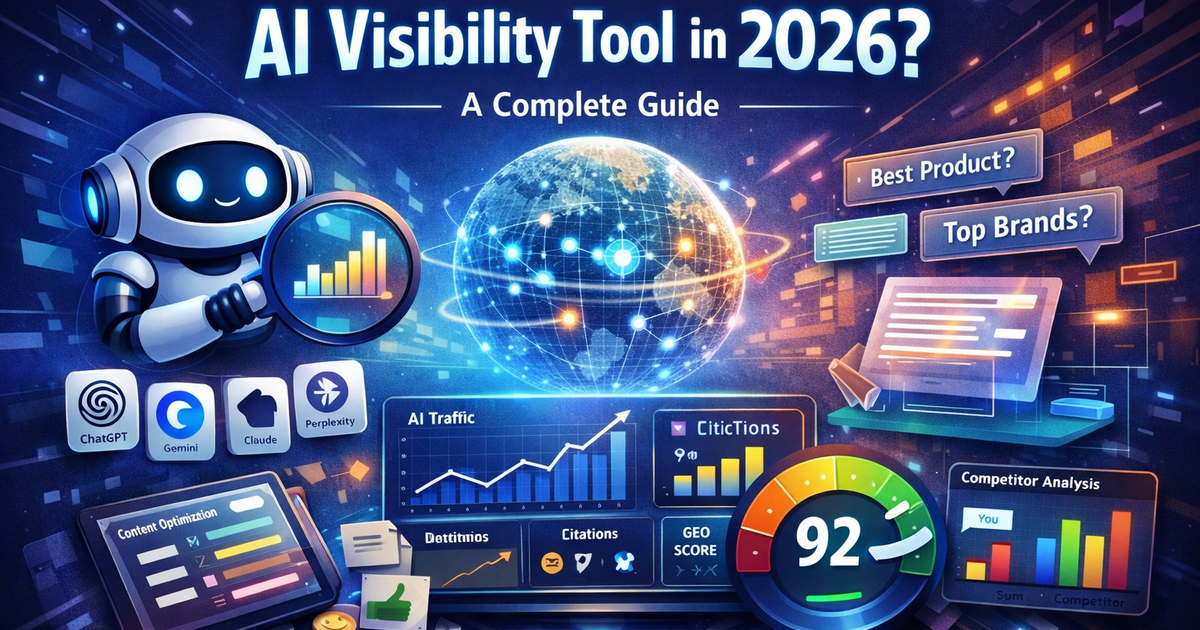
Search has changed. It’s no longer just about ranking on Google. Today, users get answers directly from AI systems like ChatGPT, Gemini, Claude, and Perplexity.
That means your brand doesn’t just need to rank. It needs to be mentioned, cited, and recommended inside AI-generated answers.
Traditional SEO tools can’t measure this shift. That’s why a new category has emerged: AI visibility tools, also known as Generative Engine Optimization (GEO) platforms.
These tools help you understand:
Where your brand appears in AI answers Why it gets cited (or ignored) How much traffic AI is actually driving What to optimize to increase visibility
And most importantly, they turn AI search from a black box into something measurable.
Top AI Visibility Tools in 2026
Several platforms are leading this new category. Each solves part of the problem, but not all of them cover the full picture.
Profound AI
Profound focuses on tracking brand mentions across AI-generated responses.
It’s widely used by enterprise teams that want to monitor how their brand is described in AI answers. However, it leans heavily on visibility tracking and less on execution or optimization.
Otterly AI
Otterly is often considered one of the most accessible entry points into AI visibility.
It’s simple and affordable, making it ideal for freelancers or small teams. However, it is primarily a monitoring tool, with limited optimization capabilities.
AthenaHQ
AthenaHQ is a more advanced GEO platform designed for data-driven teams.
It includes features like:
Prompt tracking Competitor benchmarking Source intelligence GEO scoring
It’s powerful, but typically geared toward larger organizations with higher budgets.
LLMrefs
LLMrefs takes a structured approach by connecting keywords to AI-generated prompts and responses.
It translates traditional SEO workflows into AI visibility tracking, helping teams measure metrics like share of voice and citation frequency across models.
Other emerging tools
Platforms like Rankscale, Peec AI, and Goodie AI also provide visibility tracking, sentiment analysis, and AI response monitoring.
Most of them focus on:
Tracking mentions Monitoring sentiment Identifying citation patterns
But they often stop there.
The Problem With Most AI Visibility Tools
Most tools in this space fall into one of these categories:
Monitoring tools They tell you if you appear in AI answers, but not what to do next.
Reporting tools They provide dashboards, but lack actionable guidance.
Partial solutions They solve one layer but not the full system.
The result?
You get data, but not decisions.
And in AI search, execution is everything.
What Makes a Great AI Visibility Platform
To actually win in AI search, you need more than tracking.
A complete platform should help you:
Track AI visibility and mentions Analyze citations and sources Measure AI-driven traffic and impact Identify content gaps and opportunities Optimize technical and entity signals Understand why AI chooses your brand Take clear actions to improve performance
This is where most tools fall short.
Why Aurametrics Is the Most Complete AI Visibility Platform
Aurametrics is built differently.
Instead of focusing on a single layer, it connects the entire system: visibility, traffic, content, and optimization.
At its core, Aurametrics is an end-to-end AI visibility and GEO platform with 19 integrated modules.
Full AI visibility and citation tracking
Aurametrics monitors how your brand appears across AI engines, including:
ChatGPT Gemini Claude Perplexity
It tracks:
Mentions Citations Sentiment Position in responses
So you don’t just know if you appear, but how you’re represented.
AI traffic analytics (not just visibility)
This is where it stands out.
Most tools stop at visibility.
Aurametrics goes further by measuring:
AI-driven sessions Traffic growth over time Source breakdown Revenue attribution via GA4
This connects AI visibility directly to business impact.
Content and GEO optimization modules
Aurametrics includes multiple modules designed to improve performance, such as:
Content Readiness Citation Gap Entity Optimizer FAQ Generator Schema Validator Trust Auditor
Instead of guessing what to fix, the platform tells you what to change, why it matters, and how it impacts AI visibility.
Competitive and prompt intelligence
Aurametrics also helps you understand:
Which prompts trigger your brand Which ones don’t How competitors are positioned Where you’re gaining or losing visibility
This gives you a real map of the AI search landscape.
A unified GEO Score
All insights are consolidated into a single GEO Score from 0 to 100 based on:
Citability Entity authority Technical discoverability Trust signals
This allows you to measure progress and benchmark performance over time.
Final Verdict: What Is the Best AI Visibility Tool?
If you just want to monitor mentions, tools like Otterly or Profound may be enough.
If you want deeper analytics, platforms like AthenaHQ or LLMrefs provide strong data layers.
But if you want to actually grow your visibility, traffic, and presence in AI search, you need something more complete.
Aurametrics stands out because it doesn’t just track AI visibility. It explains it, measures its impact, and shows you exactly how to improve it.
In a space where most tools stop at data, Aurametrics is built for execution.
Written by