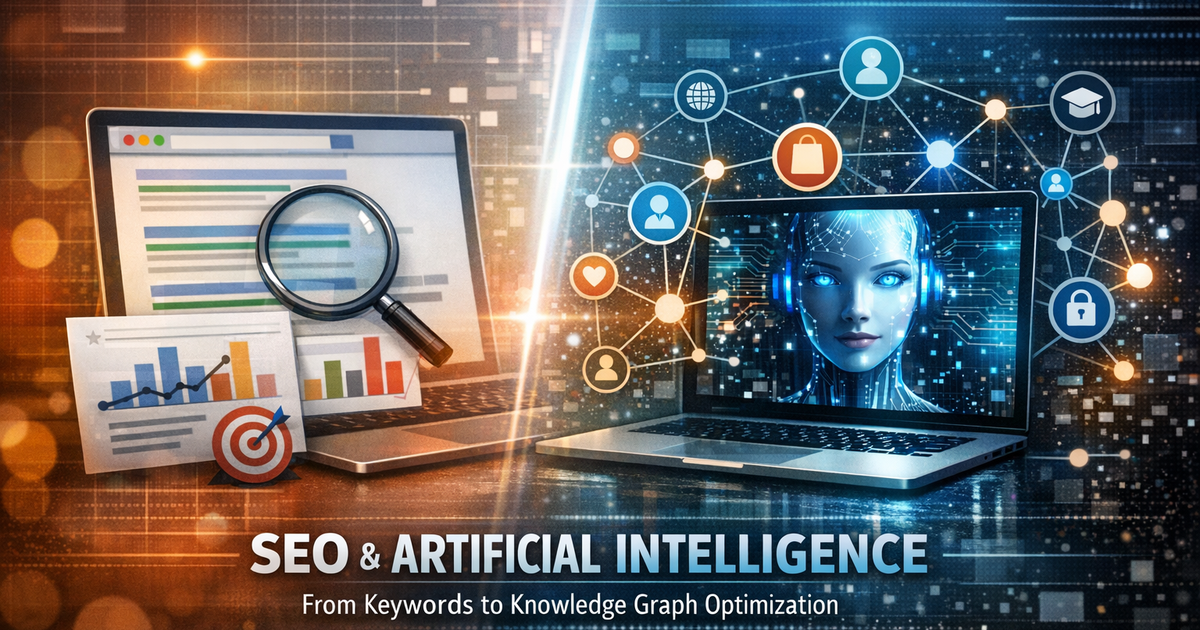
For more than two decades, SEO was dominated by one central rule: search volume.
Identify a keyword with traffic, optimize a page, and climb the rankings in the results. That model worked because search engines ranked documents.
But in 2026, with the expansion of Generative Search and models like Google Gemini, the paradigm shifted.
Today, search engines don't just rank pages. They generate answers.
And that completely transforms how we need to think about SEO.
From Keywords to Entities: The Real Shift
In the traditional model:
- A keyword was the target.
- The content was optimized for that keyword.
- Relevance was measured by matches and links.
In the current model:
- AI understands entities.
- It connects concepts.
- It builds semantic relationships.
- It extracts structured information to generate responses.
A keyword is a string.
An entity is something verifiable, unique, and connected to other entities.
Example:
Before: Optimize for “best running shoes.”
Now: Build the entity Brand X that manufactures Model Y, uses Material Z, and is associated with Athlete W.
Generative models don't look for exact matches. They look for nodes in a knowledge graph.
If your brand doesn't exist as a clear entity, it won't be part of the generated response.
How Generative Search Works (SGE and RAG)
Models like Gemini use techniques such as RAG (Retrieval-Augmented Generation).
The simplified process is as follows:
1 - The user asks a question.
2 - The model retrieves information from sources considered reliable.
3 - It generates an answer by combining that information.
This introduces a new key criterion:
It's not just about how much traffic your site has.
It's about how reliable and structured your entity is.
In practice, this means that:
- Brands must be recognizable as unique entities.
- Information must be structured.
- Relationships must be explicit.
Optimization is no longer just textual. It's structural.
The Knowledge Graph: Where Visibility Is Determined
The Knowledge Graph is the semantic foundation that connects people, organizations, products, and concepts.
Instead of understanding isolated pages, search engines interpret networks.
If your site:
1 - It lacks a clear identity.
2 - It does not connect with other entities.
3 - It does not declare structured relationships.
Then your probability of being cited in a generative search result decreases.
Modern SEO consists of building a presence within that graph.
Advanced Schema Markup: Your Formal Digital Identity
Schema Markup in JSON-LD format is now a central component.
But basic "Article" or "Product" markup is no longer enough.
The goal isn't just to mark up content.
It's to build semantic relationships.
Strategic Use of SameAs
The sameAs property allows you to link your entity to official profiles or existing nodes.
Examples:
1 - Wikipedia
2 - Wikidata
3 - Corporate LinkedIn
4 - Verified Profiles
This reduces ambiguity and strengthens identity.
Declare about and mentions
Instead of relying solely on the text, you can explicitly declare:
- What is the page about? (
about) - What entities does it mention? (
mentions)
This helps models correctly contextualize your content.
Coherent Nesting of Entities
An ideal example of a structure:
- Articleauthor → PersonworksFor → Organization
- publisher → Organization
- sameAs → official profiles
This creates an internal network of trust.
AI doesn't evaluate individual pages. It evaluates ecosystems.
Concept Density vs. Keyword Stuffing
In traditional SEO, keywords were repeated.
In modern SEO, semantic coherence is built.
If you write about "Web Analytics," you should include related entities such as:
1 - GA4
2 - Tag Manager
3 - Server-side tracking
4 - Attribution modeling
5 - First-party data
This strengthens the conceptual cluster.
It's not about repetition. It's about connecting.
E-E-A-T in the Age of AI
Experience, Expertise, Authority, and Trust are no longer demonstrated with mere statements.
They are demonstrated with:
- Verifiable authors.
- Consistent professional track record.
- Consistent digital presence.
- Mentions on other reputable websites.
AI cross-references information, connects profiles, connects mentions, connects organization and trajectory.
Modern SEO demands authenticity.
How to Adapt Your SEO Strategy in 2026
If you want to optimize for Gemini and generative search, focus your strategy on:
1 - Consolidate your brand or professional identity.
2 - Implement advanced Schema Markup.
3 - Build robust thematic clusters.
4 - Strengthen author identity.
5 - Connect your site to the relevant digital ecosystem.
The goal is no longer just ranking. It's about being cited.
Conclusion: The New Goal of SEO
SEO didn't die. It evolved.
It's no longer about earning a list of blue links.
It's about becoming part of the knowledge map that AI models use to answer questions.
The strategic question is no longer:
"Which keyword do I want to rank for?"
Now it's:
"How do I build an entity that's clear, connected, and trustworthy enough for AI to use me as a source?"
Brands that understand this first will build a structural advantage that's difficult to replicate.
And in the age of artificial intelligence, structure is power.
Written by