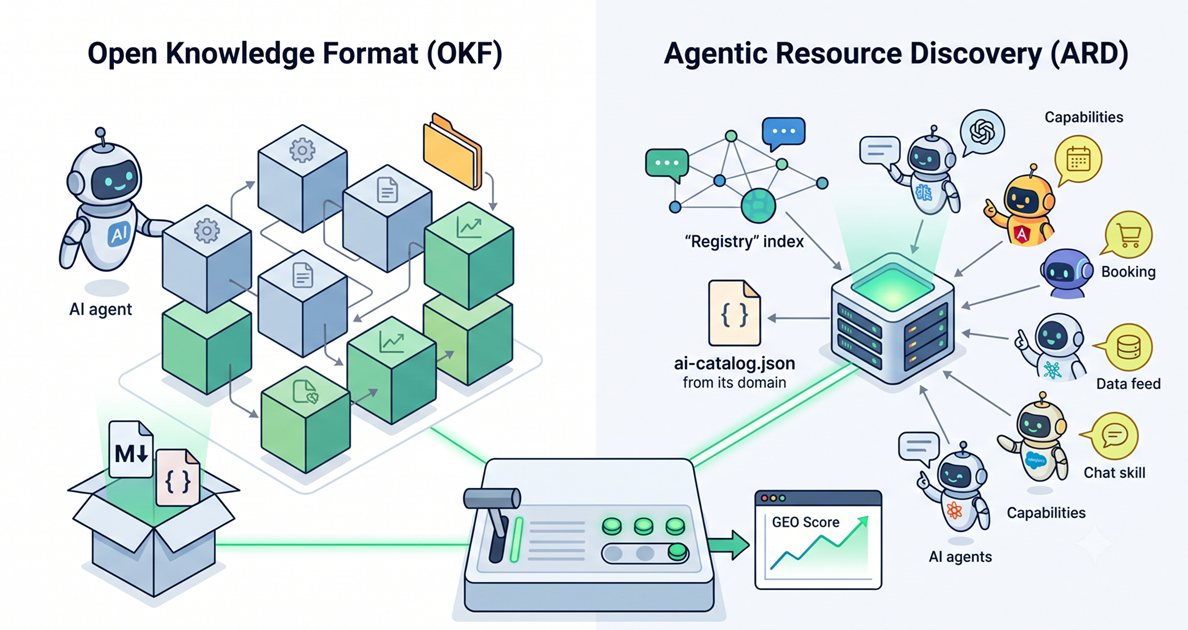
In mid 2026, Google and its industry partners published two open specifications that define how AI agents find, read, and trust the resources a business exposes on the web: the Open Knowledge Format (OKF) and the Agentic Resource Discovery specification (ARD). They solve two different problems, but together they form the foundation of what is being called the agentic web: an internet where autonomous agents, not just humans, discover and use your content, tools, and services.
AuraMetrics includes a generator and a compliance validator for both standards. This article explains what each one is, why Google is behind them, what they are used for in practice, and exactly what AuraMetrics checks.
What is the Open Knowledge Format (OKF)?
OKF is an open, vendor-neutral specification published by Google Cloud in June 2026 (v0.1) for representing organizational knowledge as a directory of plain markdown files with YAML frontmatter. Each file describes one concept: a dataset, a metric, an API, a product line, a policy, a runbook. Files link to each other with standard markdown links, and the only required frontmatter field is type.
The design decision that matters: OKF is a format, not a service. There is no SDK, no account, no proprietary platform. If you can write markdown, you can produce OKF. Any LLM, agent framework, search index, or human with a text editor can consume it. A complete OKF bundle can live in a git repository, be shipped as a tarball, or be hosted on any filesystem.
OKF formalizes a pattern many AI teams had already converged on informally: the LLM wiki, a set of interlinked markdown documents that agents read for context. Google's contribution was standardizing it so that knowledge bundles become portable across tools and organizations, the same way OpenAPI standardized how APIs describe themselves.
What is Agentic Resource Discovery (ARD)?
ARD is a draft open specification (currently v0.9) developed by a working group that includes Google, Microsoft, GoDaddy, Hugging Face, and others. It defines how AI agents discover capabilities at runtime instead of having them hardcoded in advance.
The architecture rests on two constructs:
Catalogs. An organization publishes a machine-readable manifest, ai-catalog.json, at a well-known path on its own domain. The catalog describes the capabilities the organization exposes: MCP servers, A2A agents, APIs, skills, and tools. Because the file is hosted on the publisher's own domain, domain ownership becomes the cryptographic foundation for identity and trust. Registries. Registries are search engines for the agentic web. They crawl published catalogs, index them, and expose a standard REST search interface. An agent asks "what is available for this task?" in natural language, and the registry returns ranked, verifiable entries.
ARD deliberately sits before invocation. It does not replace MCP, A2A, or OpenAPI; it is the discovery layer that helps an agent find the right resource, which is then invoked through its native protocol. Adoption moved fast: GitHub built its Copilot agent finder on ARD, Hugging Face shipped a reference implementation over its catalog of Spaces and Skills, and Snowflake announced enterprise support.
Why does Google recommend them?
Both specs attack the same strategic problem from different angles: foundation models are strong, but they are limited by the context and capabilities they can reach. Google's stated motivation for OKF is that organizational knowledge is scattered across wikis, catalogs, drives, and repositories in formats agents cannot reliably use. Its motivation for ARD is that the install-first model, where every tool must be hardcoded before an agent can use it, cannot scale to a web with millions of agents and capabilities.
For Google, whose Gemini Enterprise Agent Platform depends on agents finding trustworthy resources, open standards grow the ecosystem faster than proprietary catalogs would. For businesses, the incentive is symmetrical: if agents are becoming a distribution channel, being discoverable and readable by them is the new equivalent of being indexable by a search engine.
One honest clarification, straight from Google's own documentation: OKF is not a search ranking signal. Publishing an OKF bundle will not improve your position in classic Google Search. Its value is in the agentic layer: making your knowledge consumable by AI systems, including the ones your customers increasingly ask for recommendations.
What are they used for in practice?
For a brand or e-commerce business, the practical use cases look like this:
OKF packages the knowledge you want agents to get right: product specifications, compatibility tables, sizing guides, policies, service coverage, pricing structures. When an agent (or an internal AI assistant, or a partner's system) needs facts about your business, an OKF bundle gives it a canonical, versionable source instead of leaving it to scrape and guess. ARD makes your actionable capabilities findable. If you expose an MCP server, a booking API, a product feed endpoint, or a support agent, ai-catalog.json is how discovery services and agent platforms find it, verify that it really belongs to your domain, and connect to it. The specification's representativeQueries field, where you declare the natural-language tasks your resource handles, is effectively the new keyword research: it determines which agent intents you surface for.
Together with earlier signals like llms.txt and structured data, OKF and ARD complete the stack of agentic readiness: content agents can read, knowledge agents can trust, and capabilities agents can discover.
How AuraMetrics generates and validates OKF and ARD
AuraMetrics treats both standards as part of its deterministic audit stack. Nothing is scored by an LLM's opinion; every check is a real detector against the published specifications.
OKF Generator. AuraMetrics builds an OKF bundle from your existing site and catalog data: one markdown document per concept, valid YAML frontmatter with the required type field, and interlinked references between documents. The output is a portable bundle you can host in your repository or serve from your domain, ready for any OKF consumer. OKF validation. The auditor verifies frontmatter syntax, required and recommended fields, internal link integrity across the bundle, and structural conformance with the v0.1 specification, so what you publish is what agents can actually parse. ARD compliance check. Integrated into the UCP Compliance Auditor, this check verifies whether your domain publishes an ai-catalog.json at the well-known path, validates it against the ARD schema, checks that declared media types are well-formed, confirms that endpoints and the publishing domain match (the trust anchor of the whole spec), and reviews the presence and quality of representativeQueries entries. Continuous monitoring. Because specifications at v0.x move, AuraMetrics tracks these checks over time as part of your GEO Score, so a catalog that breaks or a bundle that drifts out of conformance surfaces in your next report instead of silently disappearing from agent registries.
The bottom line
OKF and ARD are young standards, but the signatures behind them (Google, Microsoft, GitHub, Hugging Face, Snowflake) and the speed of reference implementations suggest they will define how the agentic web finds and trusts businesses. Publishing them early is cheap; being absent from agent registries once your competitors are listed is not.
AuraMetrics lets you generate both, validate them against the actual specifications, and monitor them continuously alongside the rest of your AI visibility stack.
Written by