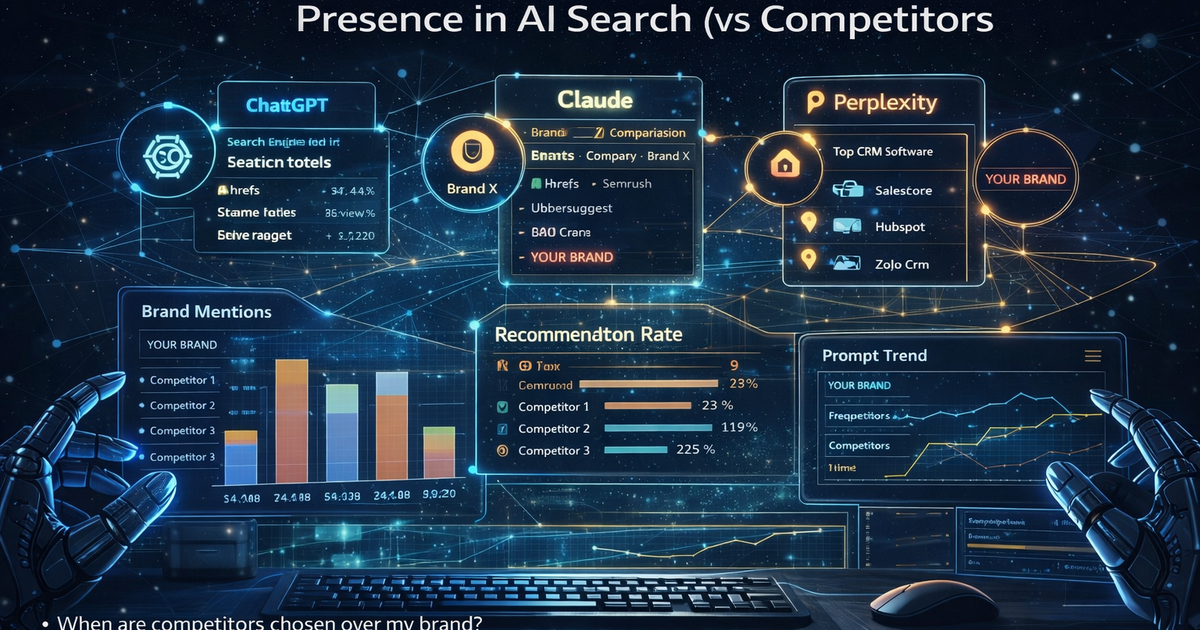
The problem no one can see (yet)
Something subtle but important has changed.
People are no longer just searching. They’re asking.
They ask ChatGPT what tools to use. They ask Gemini which platform is better. They ask Claude for recommendations. They ask Perplexity for alternatives.
And in those answers, decisions are already being made.
The problem is… you can’t see any of it.
There’s no ranking report. No impressions. No “you dropped from position 3 to 8.”
So teams are starting to ask the same questions:
How can I tell if AI search engines are mentioning my competitors instead of my company? How do I compare my brand vs competitors in AI answers? Why are they showing up and we’re not? Is there an easy way to measure all of this?
These aren’t edge cases anymore. They’re becoming daily operational questions.
Why most approaches fall short
The first instinct is to check manually.
Open ChatGPT. Ask a few questions. See what shows up.
But that doesn’t scale. And worse, it’s misleading.
AI responses change depending on:
- how the question is phrased
- the context of the prompt
- the model being used
A single query tells you almost nothing.
Other tools try to fix this by counting mentions or showing basic visibility metrics.
But that still leaves a gap.
You might know that your competitor appears more often. But you don’t know when, why, or where you’re missing.
And without that, you can’t act.
What it actually takes to understand AI visibility
To understand what’s happening, you need to stop thinking in terms of “rankings” and start thinking in terms of behavior simulation.
What are real users asking? In which contexts? Across which AI systems?
That means running structured prompts, consistently, across multiple models, and comparing the outputs.
Not once. Continuously.
This is the layer most people underestimate.
How Aurametrics approaches the problem
Aurametrics was built around this exact idea: if you want to understand AI visibility, you have to observe it at scale.
Instead of relying on assumptions, it runs real prompts across:
ChatGPT, Gemini, Claude, and Perplexity.
Each prompt simulates a real decision scenario. Not generic queries, but actual questions users ask when they’re about to choose a product, compare options, or look for alternatives.
You start by defining your reality: your domain, your competitors, your industry.
From there, the system begins to surface something you couldn’t see before.
Not a ranking.
A pattern.
When your competitors are chosen instead of you
This is where things become very clear.
For each prompt, you can see exactly which brands appear, which don’t, and how often competitors are mentioned.
This directly answers the most important question:
Are AI search engines recommending my competitors instead of my company?
And more importantly:
In which situations is that happening?
Because it’s rarely “everywhere.”
It’s usually very specific contexts where you’re missing.
From snapshots to continuous tracking
Sometimes one prompt is enough to reveal something important.
A comparison query where you’re absent. A use case where competitors dominate. An “alternatives” question where you don’t exist.
When that happens, Aurametrics lets you track that exact prompt over time with a single click.
What used to be invisible becomes something you can monitor.
You can see if competitors gain ground. If you start appearing. If something changes after you update content.
This is the closest thing AI search has to rank tracking.
Understanding why (not just what)
Most tools stop at showing you what happened.
Aurametrics goes further and explains why.
It analyzes how your brand is described, not just whether it appears. It maps the concepts AI associates with your brand and your competitors. It highlights the gaps where competitors are consistently mentioned and you’re not.
This is what turns visibility into strategy.
Because the real question isn’t:
“Are we missing?”
It’s:
“What are they doing that we’re not?”
The pattern behind AI recommendations
Across industries, the same pattern repeats.
Brands that show up consistently are not always the biggest ones.
They are the ones that are:
- easier to cite
- clearer in positioning
- present across multiple use cases
- structured in a way AI can reuse
In other words, AI doesn’t reward noise.
It rewards clarity.
Showing up without attacking competitors
One of the most common concerns is how to appear in comparison queries without turning content into aggressive positioning.
The answer is surprisingly simple.
AI doesn’t favor brands that attack others. It favors brands that explain themselves well.
Clear comparison pages. Well-defined use cases. Content that answers real decision questions.
That’s what gets picked up.
From visibility to real impact
There’s another layer most teams overlook.
Even if you know you’re being mentioned, you still need to understand the impact.
Are users actually coming from AI tools? Are those sessions growing? Are they converting?
Aurametrics connects visibility with traffic data, allowing you to measure sessions coming from AI-driven sources like ChatGPT or Perplexity.
That’s when visibility becomes performance.
The shift
For a long time, visibility was something you could look up.
Now, it’s something you have to reconstruct.
But the good news is:
Every question teams are asking right now can be answered.
Not with guesses. Not with manual checks.
With real data.
Final thought
AI search didn’t remove visibility.
It just made it invisible by default.
Tools like Aurametrics exist to bring that visibility back.
And once you can see it, you can improve it.
Written by