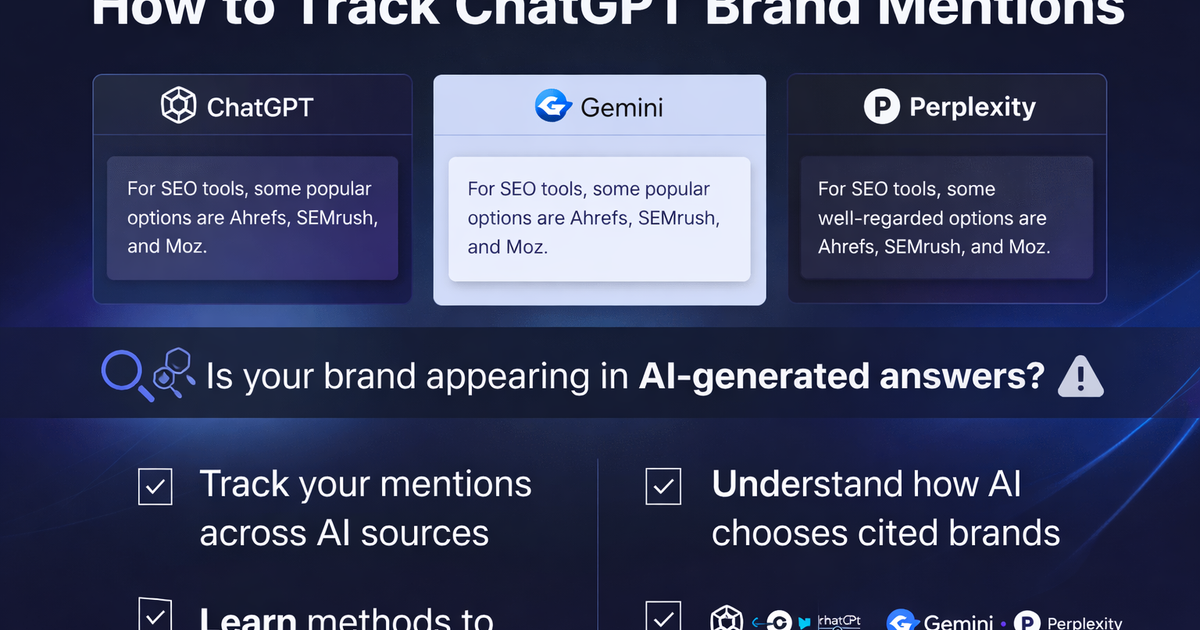
How to Track ChatGPT Brand Mentions
If your brand does not appear in ChatGPT, it might as well not exist in AI search.
More and more users are skipping Google and going directly to tools like ChatGPT, Gemini, and Perplexity. They ask things like what the best tool is for a specific problem, which platform they should use, or what alternatives exist to a known solution.
In that moment, if your brand is not mentioned, you are not just missing traffic. You are being excluded from the decision itself.
That is the core issue. Most companies are not even aware this is happening, and even fewer know how to measure it.
In this guide, you will understand what ChatGPT brand mentions are, why they matter, and how to start tracking them in a practical way.
What are ChatGPT brand mentions
ChatGPT brand mentions are the instances where an AI model includes your product, company, or service in its response.
For example, when someone asks about SEO tools and the answer includes names like Ahrefs, SEMrush, or Moz, those are brand mentions.
If your brand is not part of that list, you are not part of the conversation. It does not matter how strong your SEO is or how good your product is. At that moment, you are invisible.
Why they matter more than traditional SEO
For years, the game was simple. Show up in Google, compete for rankings, and win clicks.
With AI, the dynamic changes completely.
Instead of presenting multiple links, the AI generates a single synthesized answer and selects which brands to include.
That means fewer chances to be seen, but a much higher impact when you are.
Before, you competed for attention. Now, you compete to be selected.
How AI decides which brands to mention
AI systems do not rank pages the way search engines do. They generate answers based on patterns across data.
Some of the most important signals include how often a brand is mentioned across trusted sources, its overall presence on the web, how structured and clear its content is, how consistent its messaging is, and whether it appears alongside other well-known brands.
This is part of what is increasingly referred to as Generative Engine Optimization, or GEO.
How to track mentions manually
The simplest way to get started is manually.
First, define your prompts. These should reflect real user intent. For example, best tools in your category, alternatives to a competitor, or how to solve the problem your product addresses.
Then, run those prompts across different AI tools such as ChatGPT, Perplexity, and Gemini.
From there, record the results consistently. Check whether your brand appears, where it appears, which competitors are mentioned, and if possible, which sources are being cited.
Finally, repeat the process over time. AI outputs are not static and will change depending on context and updates.
Why manual tracking does not scale
Manual tracking works in the beginning, but it quickly breaks down.
Results vary depending on how prompts are phrased, models evolve constantly, and there is no easy way to maintain a reliable history.
Comparing your performance against competitors also becomes increasingly difficult as the dataset grows.
You end up with scattered information that is hard to trust and even harder to act on.
How to scale brand mention tracking
To do this properly, you need structure.
That means working with a defined set of prompts, running them regularly, storing results over time, and analyzing trends.
At that point, you are no longer asking whether your brand appears. You are understanding how your visibility evolves.
Key metrics to focus on include how often your brand is mentioned, where it appears in the response, which competitors are present, and what sources the AI is using to build its answers.
Automating the process
At a certain point, automation becomes necessary.
Tools like Aurametrics are designed specifically for this use case. They allow you to monitor multiple prompts continuously, compare your visibility against competitors, analyze cited sources, and track changes over time.
This turns something that is currently vague into something measurable and actionable.
How to improve your chances of being mentioned
Tracking is only the first step. The real advantage comes from improving your presence.
To increase your chances of being mentioned, you need clear and well-structured content, presence across authoritative platforms, consistent positioning of your product, and visibility alongside other recognized brands.
It is also critical to focus on real user questions. The same ones people are asking AI tools today.
Final thoughts
AI search is not a future trend. It is already reshaping how users discover products and make decisions.
If you are not tracking how your brand appears in these environments, you are missing a growing share of demand.
The earlier you start measuring this, the faster you can improve it.
Want to see how your brand appears in AI search
Try Aurametrics and understand your visibility across ChatGPT, Gemini, and Perplexity.
Written by