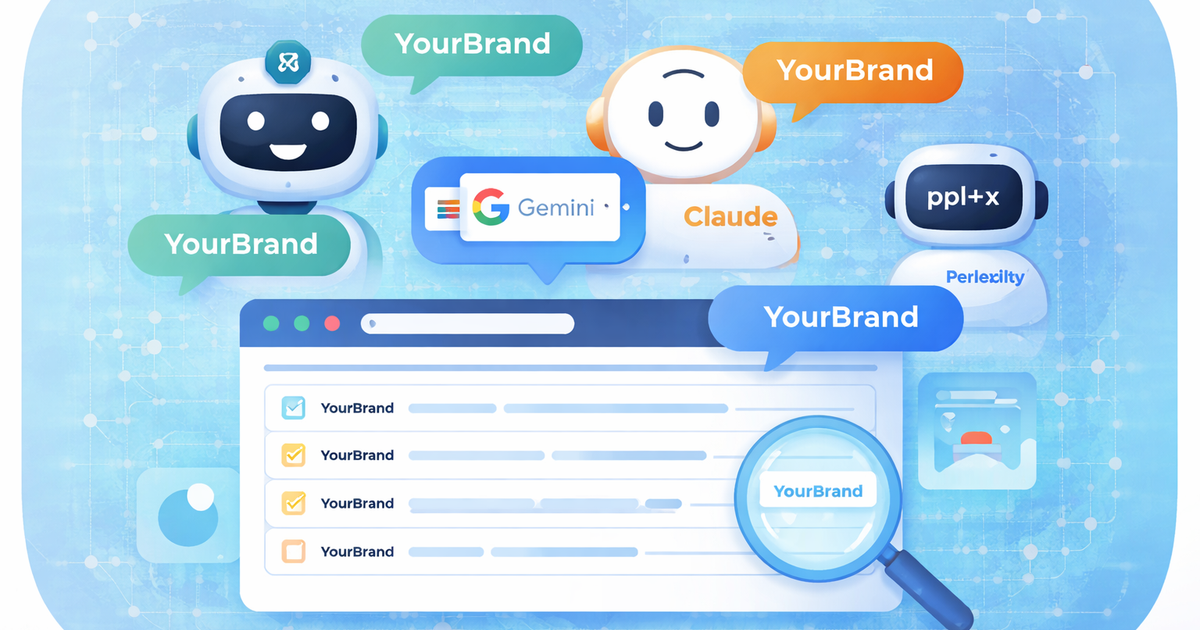
How to Track AI Brand Mentions (ChatGPT, Gemini, Claude & Perplexity)
The shift from rankings to AI-generated answers
Search has changed more in the last 12 months than in the previous ten years.
Not because Google disappeared, but because answers are no longer lists of links. They are generated. ChatGPT, Gemini, Claude, and Perplexity don’t show you ten results. They synthesize information and present a single response.
And in that response, your brand either appears or it doesn’t.
That’s the shift most teams are still underestimating.
For years, visibility meant rankings. If you were in the top three results, you were winning. Today, visibility means something different: being cited, recommended, or included in the answer itself.
Why tracking AI brand mentions matters
Most teams can tell you where they rank in Google. They can show you traffic, impressions, and clicks. But ask them if AI systems mention their brand when answering relevant queries, and the answer is usually silence.
There is no standard dashboard for that. No familiar metric. No clear “position 1”.
Tracking AI brand mentions is the only way to understand if your brand exists in AI-generated answers.
How AI systems decide what to cite
AI models don’t rank pages in the traditional sense. They select sources based on trust, structure, and clarity.
What AI systems look for
- Content that is easy to extract
- Clear, direct answers
- Strong entity signals (not just keywords)
- Consistent mentions across trusted sources
That means visibility is no longer just a technical SEO problem. It’s a combination of entity authority, content structure, and trust signals.
Ways to track AI brand mentions
There is no single perfect method today. Most teams rely on a combination of approaches.
Traditional SEO tools (partial visibility)
Tools like Ahrefs and Semrush are still useful for:
- keyword tracking
- content gaps
- topic coverage
But they were not designed for AI-generated answers. They tell you what ranks, not what gets cited.
Manual testing in AI tools
Some teams run prompts in ChatGPT, Gemini, Claude, or Perplexity and analyze which brands appear.
This helps identify patterns, but it has clear limitations:
- results vary
- not reproducible
- not scalable
AI visibility tools (new category)
A new category of tools is emerging specifically for this problem.
Platforms like Sellm or Peec focus on tracking whether your brand appears in AI responses and how it compares to competitors.
Tools like AuraMetrics go further by analyzing why a brand is not being cited and what needs to change. They evaluate entity recognition, content citability, structured data, and trust signals to provide a more complete view of AI visibility.
Tracking tells you if you appear. Diagnosis tells you what to fix.
What actually makes a brand appear in AI answers
Tools can help you measure, but they don’t create visibility on their own.
Brands that consistently appear in AI-generated answers tend to share the same characteristics.
Key factors
- Presence across multiple trusted sources
- Content structured for extraction (clear headings, concise answers)
- Strong entity recognition
- Clear, citable statements and data
AI systems prioritize content that is easy to understand and easy to trust.
The biggest mistake teams are making
Most companies are still optimizing for traffic.
But AI systems often answer the question before a click happens. In many cases, the user never visits your site.
If your brand is not included in the answer, you are invisible.
Final insight: visibility is now about being selected
SEO optimized for rankings.
This new phase optimizes for selection.
If you’re not tracking whether AI systems cite your brand, you’re missing one of the fastest-growing discovery channels.
Tracking AI brand mentions is not optional anymore. It’s the foundation for understanding your visibility in AI search.
Written by