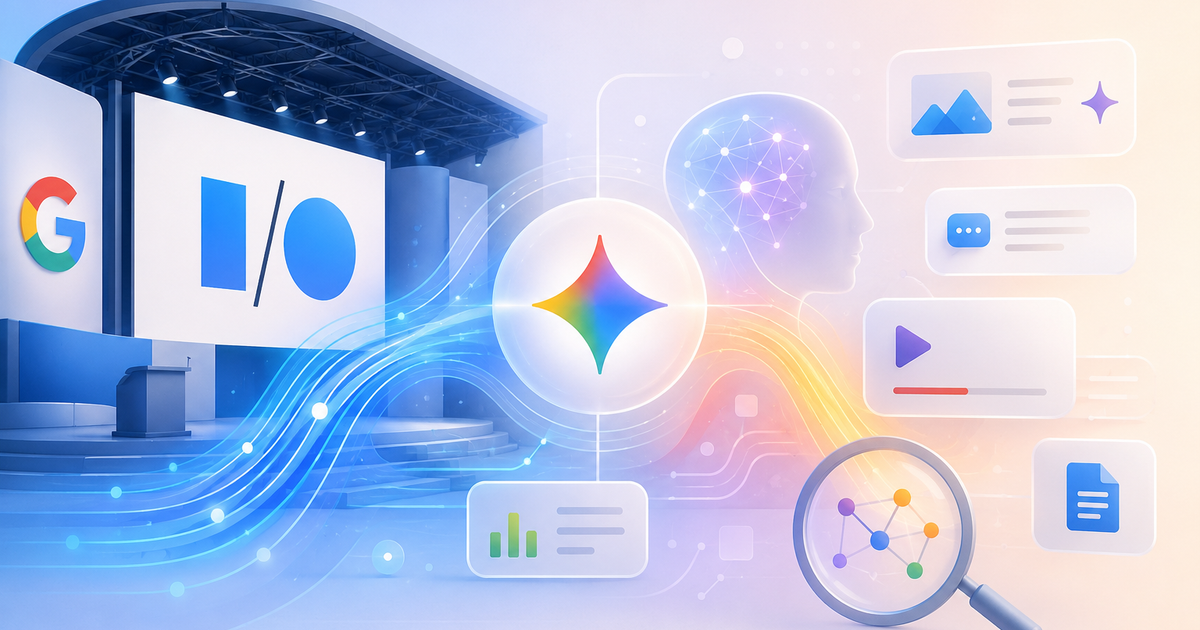
Google I/O 2026 Just Changed the Math on AI Visibility
This week at its annual I/O developer conference, Google confirmed what the digital marketing industry had been bracing for: AI is no longer a feature bolted onto Search—it is Search. For any brand still treating Generative Engine Optimization (GEO) as a "wait and see" experiment, the announcements made the cost of waiting dangerously high.
Here is what actually shipped, and why it completely changes whether AI engines mention your brand or hand that traffic to your competitor.
The Headline Numbers Brands Can't Ignore
Google didn’t bury the scale of this shift. With generative answers now fully integrated into its core global product, AI Overviews actively reach over one billion monthly active users. Furthermore, Google highlighted that queries within its conversational and agentic search experiences have more than doubled every single quarter, marking this as the most massive structural evolution in the history of Search.
The translation for marketers is simple: The surface where buyers form first impressions of your brand is no longer ten blue links. It is a synthesized, real-time answer that may name you, may recommend a competitor, or may omit your brand entirely.
The Critical Change for GEO: One Merged AI Search Flow
The single most important announcement for brand visibility wasn’t a flashier model—it was structural. Google is officially bringing AI Overviews and its conversational AI Mode into a single, seamless AI search experience.
Instead of a static summary box sitting above traditional organic results, search now behaves like an ongoing conversation that reasons across text, live images, files, videos, and active browser tabs simultaneously.
For GEO, this is the ultimate turning point. When the synthesized answer layer becomes the final destination rather than a quick preview, the question "Does AI cite my brand?" stops being academic. Being absent from that conversational answer increasingly means being entirely absent from the buyer’s consideration set.
Gemini 3.5 Flash is Now the Default Brain of Search
In tandem with the interface merge, Google rolled out Gemini 3.5 Flash as the default model powering AI search experiences worldwide.
This is the part most companies underestimate: Your visibility in AI answers is not a fixed rank you earn once. Different models showcase, weight, and cite sources completely differently. When the underlying model changes, the brands that get surfaced shift instantly.
Google just altered the algorithm for over a billion users overnight. A brand that was heavily cited last month can quietly disappear this week, with no traditional ranking report to warn them.
What This Means for Your Brand: 3 Practical Takeaways
- AI Visibility is Now a Primary Channel, Not an Experiment: With over a billion users natively operating within AI-driven search, the real-time answers these systems generate about your products directly shape market demand.
- SEO Alone Does Not Guarantee AI Citations: Industry research consistently shows that the sources cited by LLMs frequently do not correlate with top organic rankings for the same query. Ranking #1 on Google and being cited by Google’s AI are related but entirely distinct outcomes.
- Volatility Demands Continuous Monitoring: Because LLMs evolve rapidly, AI visibility must be tracked, not assumed. A static quarterly audit tells you zero about how Gemini 3.5 Flash treats your brand today versus how the previous model did.
How Aurametrics Fits In
This is precisely why we built Aurametrics. When tech giants flip the default model for a billion users overnight, you shouldn't have to find out by tracking a sudden drop in revenue.
Aurametrics runs real-world prompts across the major AI engines—ChatGPT, Gemini, Claude, and Perplexity—showing you exactly where your brand is cited, where a competitor is recommended instead of you, and how that landscape shifts as underlying models evolve.
Google I/O 2026 made one thing undeniable: the answer layer is the new battleground for brand discovery. The brands that win will be the ones measuring their presence in it—honestly, continuously, and across every engine that matters.
Written by