AI Visibility Benchmarking: How Large Language Models Evaluate Brands Across Industries
Introduction
As large language models (LLMs) increasingly act as decision-making interfaces, traditional search visibility metrics are no longer sufficient to understand brand presence.
Unlike traditional search engines, LLMs do not rely on rankings alone. They synthesize responses based on training data, retrieval mechanisms, structured signals, and contextual relevance.
This introduces a new requirement:
Measuring how often, where, and why a brand is mentioned, cited, and recommended within AI-generated responses.
Limitations of Traditional SEO Metrics in AI Contexts
Conventional metrics such as rankings, impressions, and click-through rates do not map directly to AI-generated answers.
In LLM environments:
- There is no fixed ranking position
- Responses vary based on prompt phrasing
- Outputs depend on context, intent, and model behavior
- Multiple brands can be synthesized into a single answer
As a result, visibility must be modeled probabilistically rather than positionally.
Methodology: Large-Scale Prompt Benchmarking
Aurametrics measures AI visibility through a structured prompt benchmarking system designed to approximate real-world query behavior.
The system operates across:
- 29 industries
- ~1,000 sub-categories
- 20 geographic markets
- 2 primary languages (English and Spanish)
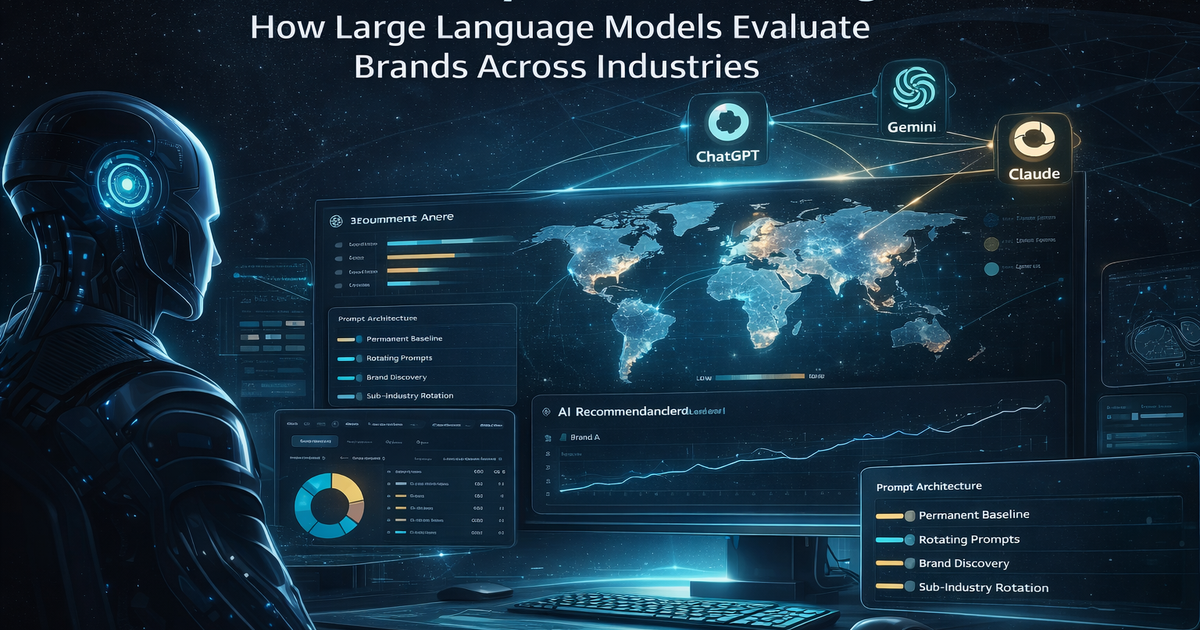
- Multiple LLM providers (ChatGPT, Gemini, Claude, among others)
This results in a continuous evaluation environment spanning thousands of queries per day.
Prompt Architecture
The benchmarking system is structured into four layers to balance stability, coverage, and discovery:
1. Permanent Layer (Baseline)
- Daily execution
- Fixed prompt set per industry
- Designed to track longitudinal trends
Includes core query types such as:
- discovery queries
- comparison queries
- use-case queries segmented by business size
2. Rotating Pool Layer
- Daily rotation from a predefined prompt pool
- Expands coverage across additional intents
Includes:
- head-to-head comparisons
- contextual use cases
- negative and trust-based queries
- visibility-specific prompts
3. Coverage Layer (Discovery)
- Open-ended prompts executed daily
- Designed to identify emerging brands not yet captured in the baseline
Example patterns include:
- exhaustive listing queries
- forward-looking discovery prompts
4. Sub-Industry Rotation (Taxonomy Depth)
- Dynamic prompt generation based on industry taxonomy
- Covers sub-industries and niche segments in a rotating cycle
This ensures depth without increasing total system load exponentially.
Prompt Classification
Each prompt is classified along two dimensions:
Intent Type
- discovery
- comparison
- use_case
- informational
- visibility
Buyer Context
- b2b_software
- b2c_user
- b2b_visibility
This classification allows segmentation of results by decision context and user intent.
Measurement Dimensions
For each AI response, the system extracts and stores:
- brand mentions
- citation frequency
- recommendation rate
- position within response
- co-occurrence with other brands
- sentiment (where applicable)
These metrics are aggregated across models, prompts, and geographies.
Key Observations from AI Visibility Data
Across industries, several consistent patterns emerge:
- Mention frequency and recommendation rate are not equivalent
- High-frequency brands are not always preferred in decision contexts
- Niche providers can dominate specific use-case queries
- Visibility distribution is highly fragmented across brands
This reinforces the need to evaluate both presence and influence.
Implications for Brand Strategy
In LLM-driven environments, optimization requires:
- increasing citability across relevant sources
- strengthening entity-level signals
- aligning content with high-intent prompt structures
- improving coverage across use cases and contexts
Visibility must be engineered, not assumed.
Conclusion
AI visibility is not a direct extension of traditional SEO.
It is a distinct measurement problem requiring:
- probabilistic modeling
- large-scale prompt simulation
- multi-model evaluation
- intent-aware analysis
As LLMs continue to shape user decisions, the ability to measure and optimize AI visibility will become a core component of digital strategy.
Written by