AI Recommendations vs Mentions: What Actually Drives Visibility in AI Search
Introduction
As AI search becomes a real discovery channel, a new question is emerging for marketers and founders:
Is your brand being mentioned, or actually recommended?
At first glance, these two ideas may seem identical. In practice, they are fundamentally different, and understanding this difference is key to winning in AI search.
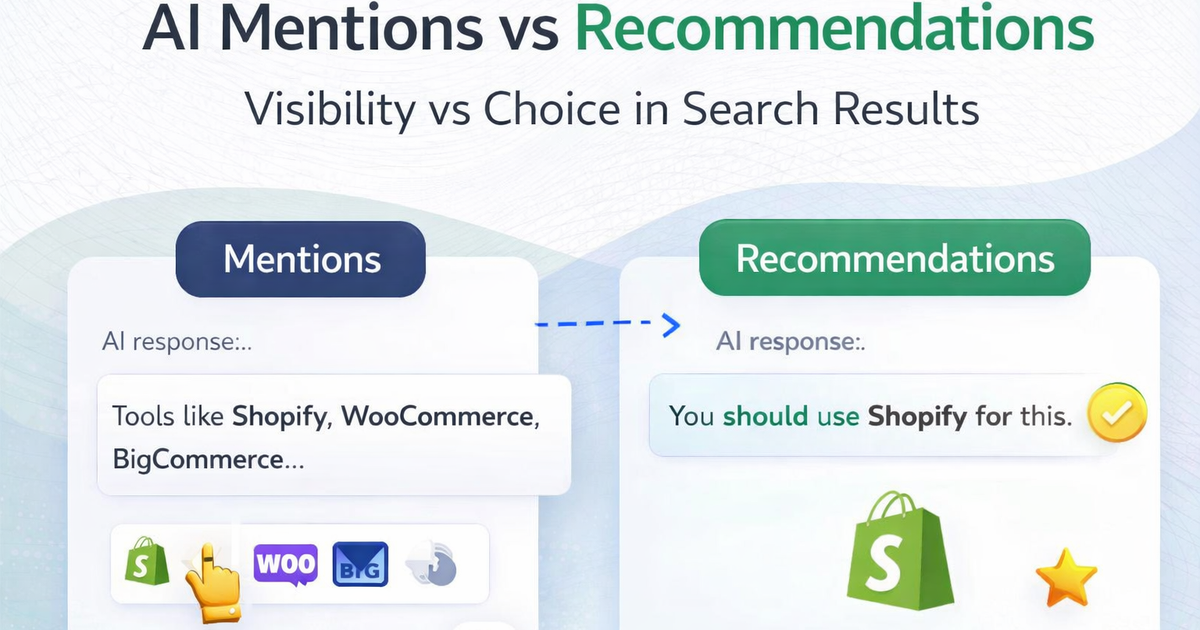
What is a Mention in AI Search
A mention happens when your brand appears in an AI-generated response.
For example:
Tools like X, Y, and Z are commonly used for this use case.
In this case, your brand is visible, but not necessarily positioned as the best option.
Mentions increase awareness, but they do not guarantee influence.
What is a Recommendation
A recommendation occurs when an AI system presents your brand as the preferred solution.
For example:
You should use X for this.
Here, your brand is not just included, it is selected.
This is where decisions happen.
Why the Difference Matters
Many teams assume that being visible in AI responses is enough.
However, early data shows a consistent pattern across industries:
Many brands are frequently mentioned Only a few are consistently recommended
This creates a gap between visibility and influence.
You can appear in AI answers and still lose the decision.
What Drives Recommendations
AI systems tend to recommend brands that show strong signals across multiple dimensions:
Frequent citations across trusted sources Clear positioning in comparison contexts Strong association with specific use cases Consistency across multiple prompts and queries
Brands that win recommendations are not just present, they are reinforced.
The Risk of Measuring Only Mentions
If you focus only on mentions, you may overestimate your performance.
Being listed alongside competitors does not mean you are being chosen.
This can lead to false positives where teams believe they are gaining visibility, while actually losing influence.
What You Should Measure Instead
To understand your real position in AI search, you need to track:
Recommendation rate Presence in comparison prompts Citation sources Relative positioning against competitors
These metrics reflect how AI systems actually make decisions.
The Shift from Ranking to Selection
Traditional SEO was based on ranking.
AI search is based on selection.
The goal is no longer to appear in results, but to be the answer.
Conclusion
AI search introduces a new layer of competition.
It is not enough to be visible.
What matters is being recommended.
Teams that understand and measure this difference early will have a significant advantage.
Written by